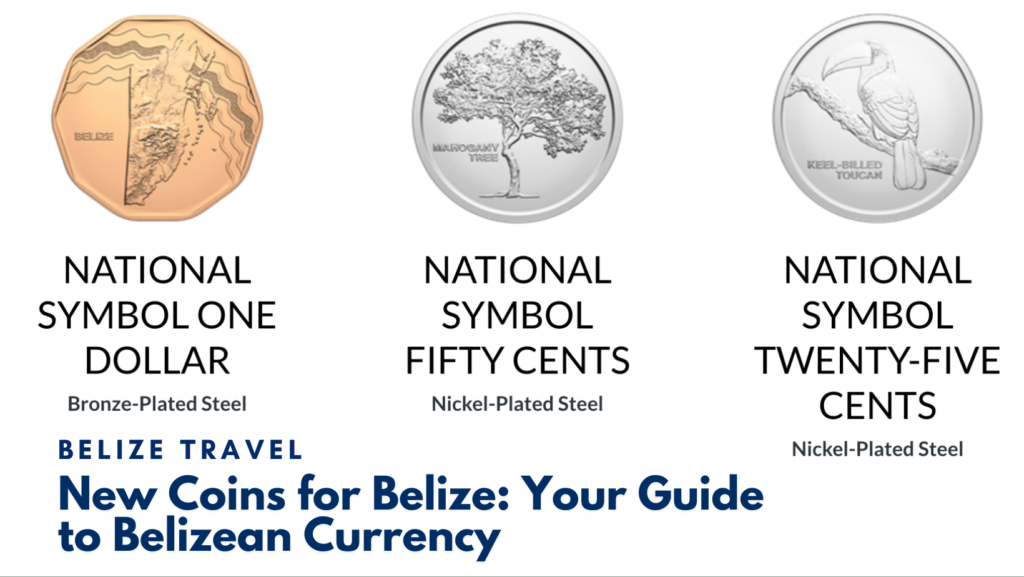
There’s a new look jingling in Belizean pockets. On September 18, 2026, Belize officially welcomed its new National Symbols Coin Series into circulation, introducing six newly designed coins inspired by the country’s wildlife, heritage, and national identity. Arriving just days before Belize celebrates its 45th Independence Day, the launch feels particularly well timed and for travelers planning a visit, it also gives us the perfect opportunity to talk about Belizean money, how it works and what you can expect to find in your wallet while exploring the country.
Meet Belize’s New Coins
Issued by the Central Bank of Belize and minted by the Royal Canadian Mint, the new series includes all six circulating denominations: 1 cent, 5 cents, 10 cents, 25 cents, 50 cents, and 1 dollar. This time, however, the designs turn their attention entirely toward Belize. The Black Orchid, Belize’s National Flower, appears on the 1-cent coin, while the Baird’s Tapir, our National Animal, appears on the 5-cent. The 10-cent coin carries Belize’s Coat of Arms, the 25-cent features the colorful Keel-billed Toucan, and the 50-cent honors the Mahogany Tree, whose history is deeply intertwined with the development of Belize. Completing the collection, the new $1 coin proudly features the map of Belize.
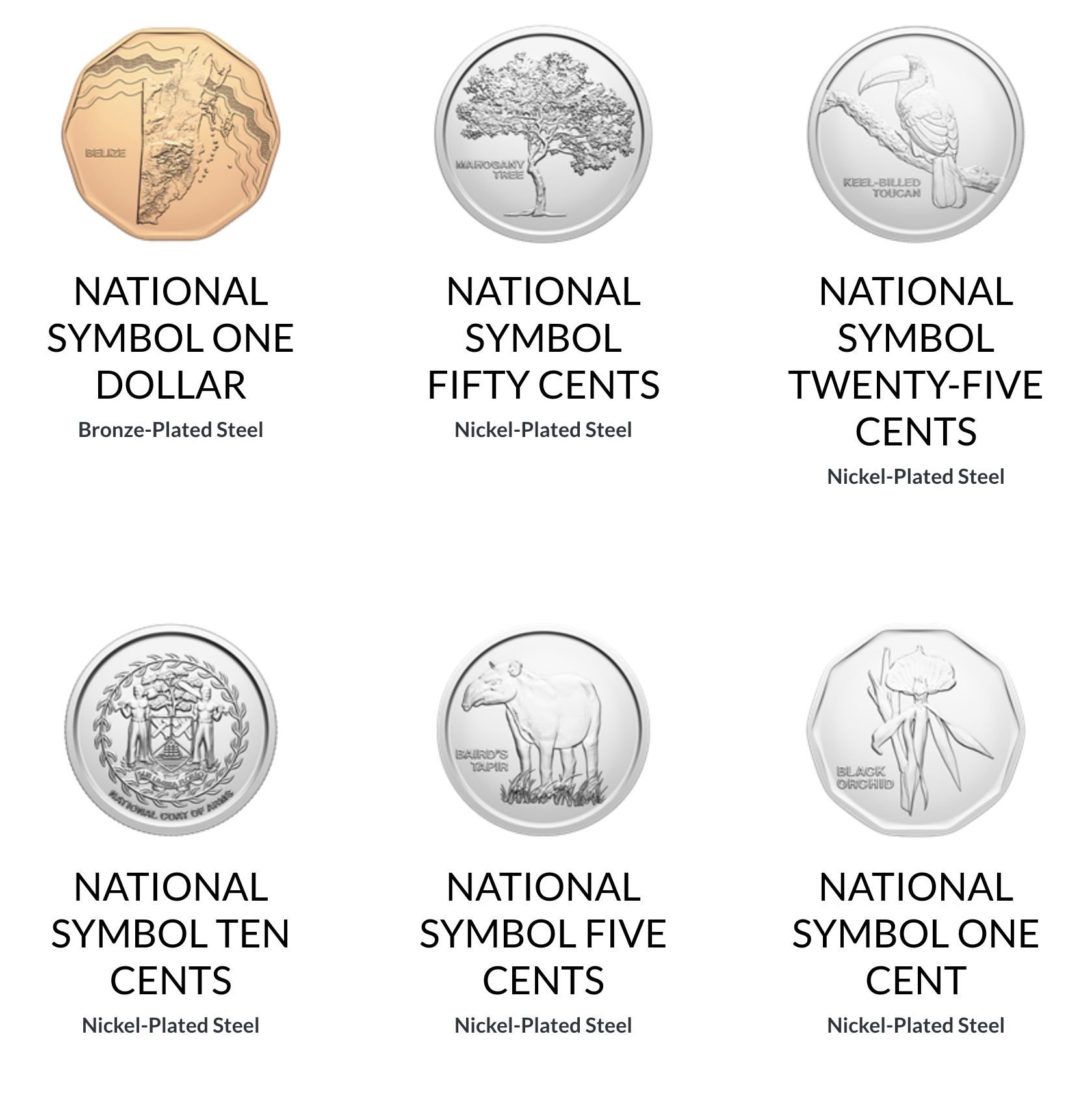
The changes go beyond the artwork. Most of the new coins are made from nickel-plated steel, while the $1 coin uses bronze-plated steel, giving it a distinctive golden-bronze appearance. They are also magnetic, lighter than some of their predecessors and designed to be more cost-effective to produce. Even the familiar Belizean penny has received an update, moving away from its old scalloped edge to a new 10-sided design.
What Happens to Belize’s Old Coins?
There’s no need to empty your drawers looking for old Belizean coins just yet. Coins bearing the image of the late Queen Elizabeth II remain legal tender and will continue circulating alongside the new National Symbols Coin Series. You don’t need to exchange them, and because coins tend to stay in circulation for many years, visitors can expect to see a mix of old and new Belizean currency for some time.
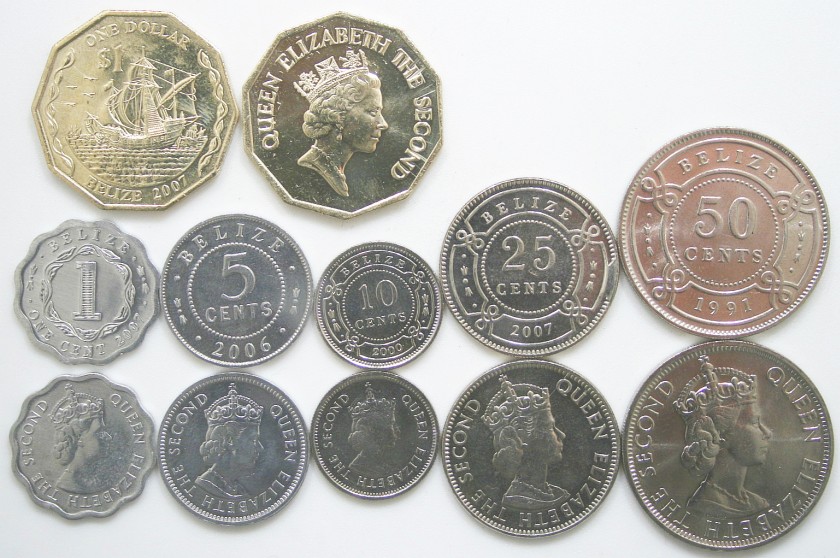
That means your pocket change may tell a small story of Belize’s changing currency an older coin from the previous series sitting alongside a new toucan, tapir or Black Orchid.
Belize’s Banknotes Have Changed Too
The new coins actually complete a much broader transformation of Belizean currency. In August 2025, Belize introduced its National Heroes Banknote Series, marking the first Belizean banknote family to move away from the British monarch as its primary portrait. The redesigned notes instead honor Belize’s two National Heroes, the Rt. Hon. George Cadle Price and the Hon. Philip Goldson, while incorporating imagery from across the country.
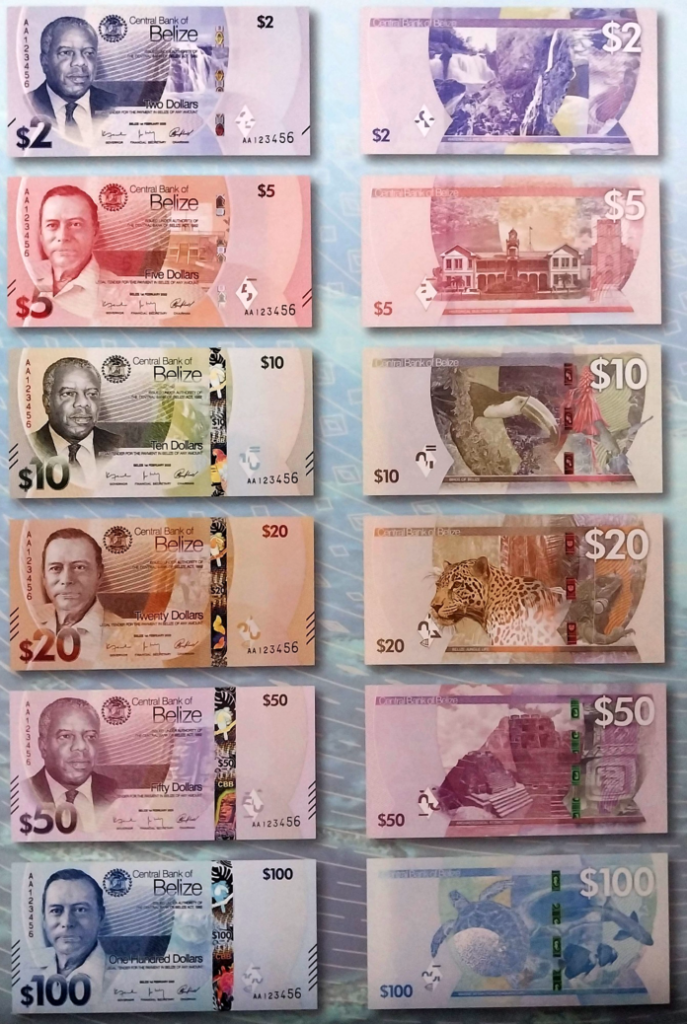
Belize’s wildlife, archaeological sites, historic buildings, landscapes and cultural heritage appear throughout the designs, accompanied by modern security features such as holographic elements, color-shifting security threads and tactile markings. Together with the new coins, the banknotes give Belizean currency a noticeably more local identity one that tells a story about the people, places and natural heritage of the country every time money changes hands.
A Traveller’s Guide to Belizean Money
Thankfully, understanding Belizean currency is remarkably simple, particularly for travelers arriving from the United States. Belize’s official currency is the Belize dollar (BZD), which has been fixed to the US dollar at a rate of BZ$2 to US$1 since May 1976. That means US$10 equals BZ$20, US$50 equals BZ$100, and so on. In fact, 2026 marks 50 years since Belize established this fixed exchange rate.
US dollars are also commonly encountered throughout Belize’s tourism economy, which makes travelling with cash relatively straightforward for American visitors. Because both currencies use the dollar sign, however, it is always worth checking whether a price is being quoted in Belize or US dollars. You may see businesses use BZ$ and US$ specifically to avoid confusion.
For smaller purchases, local markets and everyday spending, having Belize dollars on hand can be useful. Don’t be surprised if you pay in US dollars and get Belizean currency in change. With the exchange rate fixed at two-to-one, tracking it is usually as simple as dividing the Belize-dollar amount by two to get the US-dollar equivalent.
A New Belizean Keepsake
Coin collectors have something extra to look out for as part of the launch. The Central Bank has also introduced a limited-edition painted 50-cent Mahogany Tree coin, available beginning September 18. Unlike the standard 50-cent coin entering everyday circulation, the painted edition is intended as a collectible and is available individually or as part of a National Symbols Coin Series collector’s set.
For travelers, it makes a fitting little keepsake. After all, souvenirs don’t always have to come from a gift shop. Sometimes they arrive as the change from your morning coffee, lunch in San Ignacio, or an afternoon spent wandering through a Belizean market.
Belize, Right in Your Pocket
We use money so routinely that it is easy to overlook the stories printed and stamped onto it. Yet currency has always been one of the small ways a country represents itself, and Belize’s newest designs place that identity firmly at the center. From George Price and Philip Goldson on our banknotes to the Black Orchid, tapir, toucan, Mahogany Tree, Coat of Arms, and map of Belize on our coins, the images now traveling through Belizean hands are distinctly our own.
So when you visit Belize, take a second look at the change handed back across the counter. That little toucan or Mahogany Tree in your palm isn’t just part of your vacation budget; it’s a tiny piece of Belize traveling home with you.