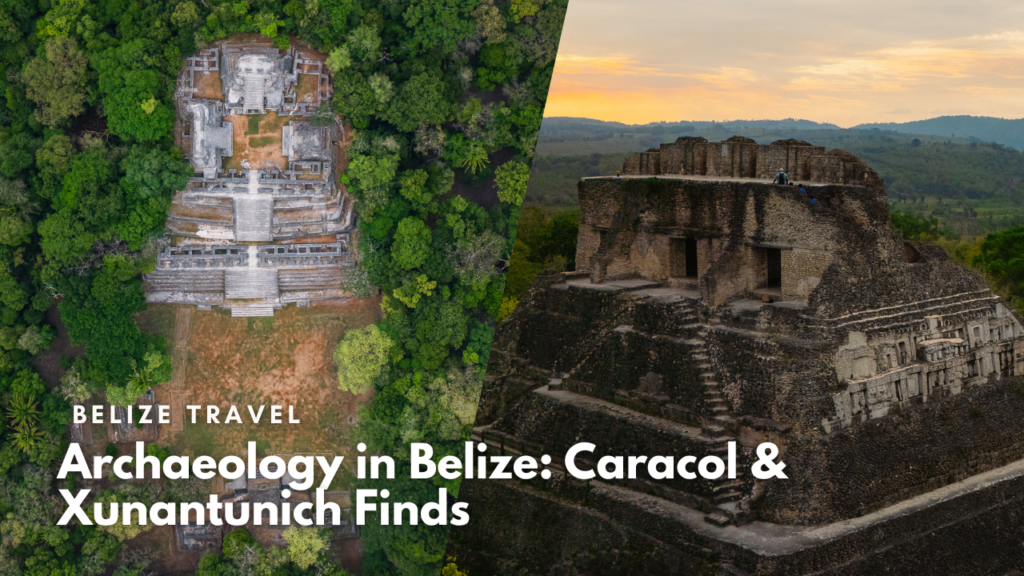
Across western Belize, ancient Maya cities continue to reveal stories buried for more than a thousand years. During the 2025 field season at Caracol, archaeologists uncovered a royal tomb linked to the city’s founding ruler, along with jade ornaments, richly decorated pottery, burials, caches and new evidence of connections across Mesoamerica. At Xunantunich, other recent research offers a rare look at how young members of Maya society may have learned art, writing, and ritual knowledge.
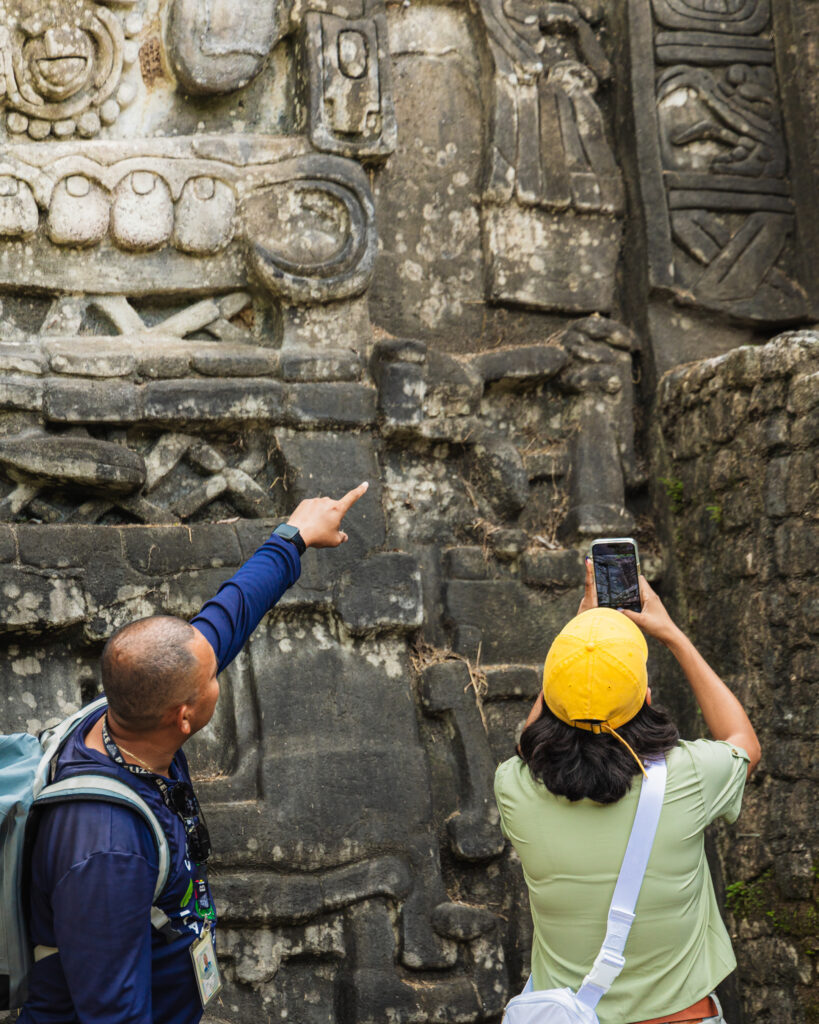
Together, these discoveries form an important chapter in the ongoing study of archaeology in Belize. They reveal not only how rulers exercised power, but also how knowledge, beliefs and artistic traditions may have been passed from one generation to the next.
A New Look at Caracol’s Early History
The 2025 investigations were led by the Caracol Archaeological Project and formed the first part of a two-year research program spanning 2025 and 2026. The fieldwork focused on the Early Classic Period, generally dated from approximately CE 250 to 550—a formative but still imperfectly understood era in Maya history.
Archaeologists examined three areas: Structure B34 in the Northeast Acropolis and two residential groups southeast of Caracol’s Central Acropolis, nicknamed “Canta” and “Ayayayay.” By studying both monumental and residential spaces, the researchers hoped to understand not only Caracol’s rulers, but also the families and communities that lived near the city’s ceremonial center.
The Tomb of Caracol’s Founding Ruler
The most remarkable discovery came from a small excavation in front of Structure B34. By reopening an earlier trench and digging beneath the floor of a previously excavated tomb, the team located a hidden Early Classic chamber.
The tomb is believed to belong to Te’ K’ab Chaak, the ruler associated with the founding of Caracol’s royal dynasty in CE 331. The chamber contained the remains of an elderly man accompanied by objects that reflected wealth, authority and sacred status.
Among the offerings were 11 pottery vessels, six large jadeite ear ornaments, jade beads, carved bone objects, Pacific spondylus shells and a jadeite mosaic mask that archaeologists were able to reconstruct. Bright red pigment, believed to be cinnabar, once covered parts of the chamber and its contents—a material frequently associated with high-status Maya burials.
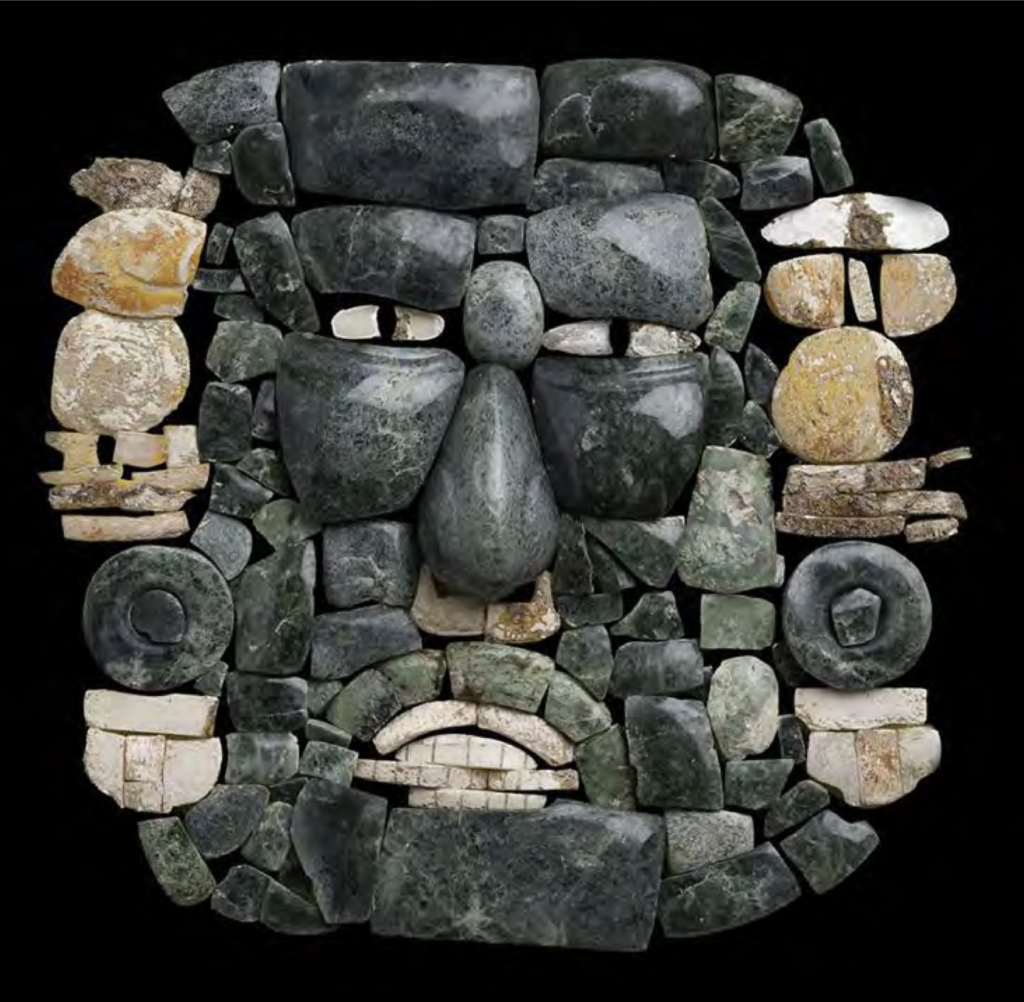
The identification of a named dynastic founder makes this one of the most significant recent discoveries in Belizean archaeology. Scientific analysis of the remains, including radiocarbon dating and stable-isotope research, was still underway when the 2025 report was prepared, so further information may refine the interpretation.
Pottery Filled With Maya Symbolism
The pottery placed inside the tomb offers another window into the ancient Maya world. Several vessels display bound captives, imagery connected to rulership and scenes associated with tribute and trade.
One vessel lid depicts Ek Chuah, a Maya deity associated with merchants and commerce, accompanied by offerings and a bundle. Another portrays an elevated ruler holding a spear while receiving offerings from supernatural figures. Other designs include a hummingbird, an owl, monkeys, a turtle shell and symbols that may refer to a dynastic origin story.
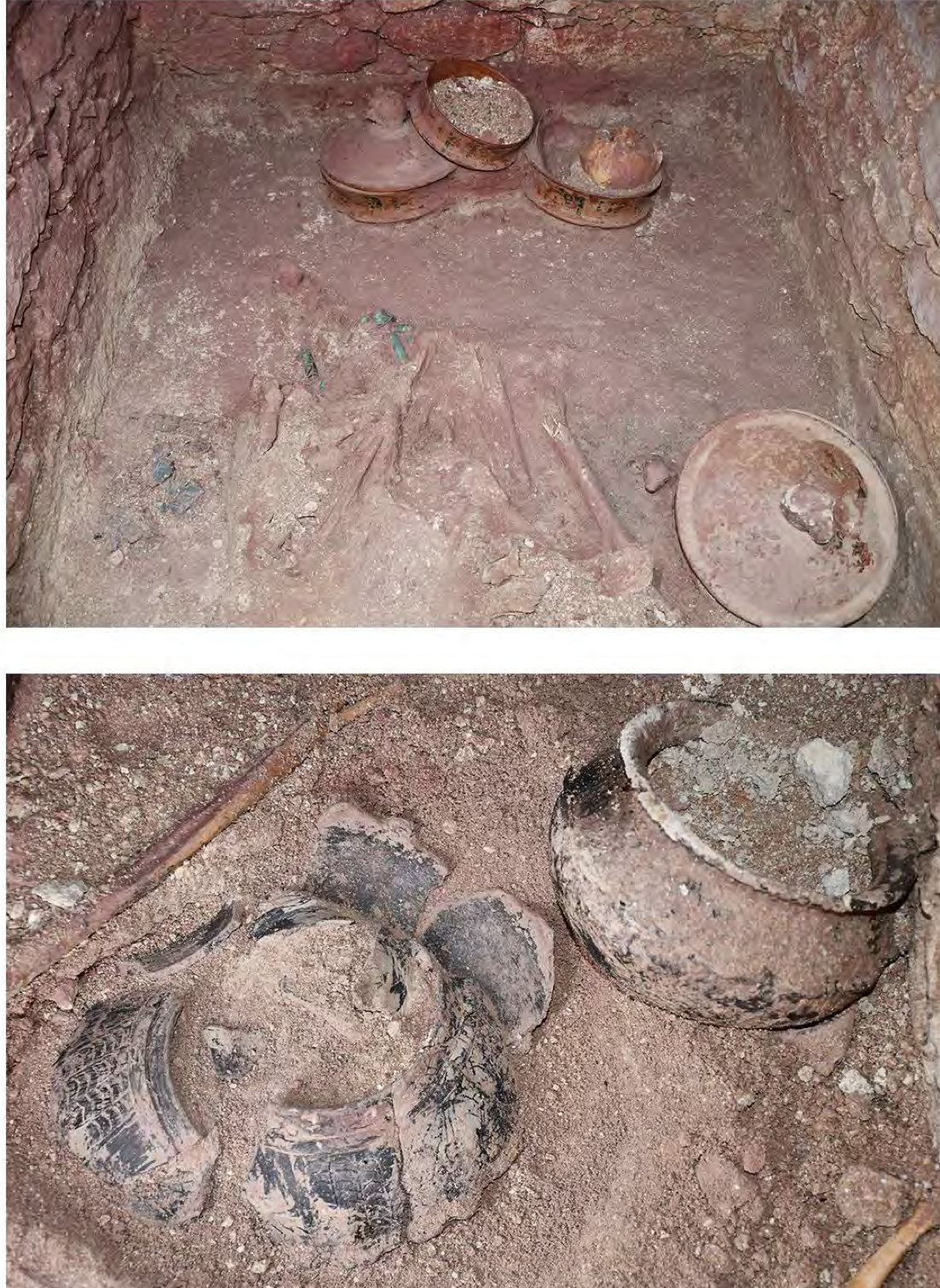
These were not simply decorative objects. Their imagery communicated ideas about royal power, warfare, exchange, ancestry and the Maya cosmos. Placed together in the tomb, they helped express the identity and authority of the person buried there.
Caracol and Teotihuacan: Trade, Influence or Something More?
One of the most fascinating questions in Maya archaeology concerns the relationship between the Maya lowlands and Teotihuacan, the great ancient city of central Mexico.
In 2010, archaeologists found a Teotihuacan-style cremation near Structure B34, dating to around CE 350. Because the newly discovered royal tomb appears to be slightly earlier, the evidence suggests that Caracol’s dynastic rulership was already established before that central Mexican-style burial was placed there.
This distinction matters. Rather than proving that Teotihuacan introduced kingship to Caracol, the sequence supports the interpretation that royal authority developed locally among the Maya. At the same time, the nearby burials and shared artistic styles point to sustained connections between Caracol’s elite and people or traditions linked to central Mexico. Researchers suggest these relationships may have involved peaceful exchange, diplomacy or trade, although the precise nature of the contact remains under study.
Discoveries Beyond the Royal Center
The 2025 season also explored two residential groups near Caracol’s epicenter. These excavations are valuable because archaeology is not only about kings, temples and spectacular treasures. Household spaces can reveal how generations of people lived, performed ceremonies, honored their dead and reshaped their homes.
At the Canta residential group, archaeologists found evidence of repeated construction, burials, tombs, caches and occupation stretching from the Late Preclassic into the Late Classic Period. Some individuals had filed teeth or dental inlays, offering clues to ancient forms of identity and personal appearance. A two-chambered underground feature known as a chultun also contained earlier materials, although excavation was stopped because its roof was considered unstable.
At Ayayayay, Structure C5 contained a particularly dense concentration of ritual deposits. The investigation recorded tombs, crypts, burials and numerous caches placed in and around the building over different periods. One tomb contained a large hieroglyphic bowl naming Ajnumsaaj, also called “Double Comb,” a ruler associated with the Maya city of Naranjo in present-day Guatemala. The vessel offers another clue to the political and cultural relationships that connected Caracol with neighboring Maya centers.
Xunantunich and a Possible Ancient Maya School
Less than 50 kilometers from Caracol, Xunantunich is contributing another extraordinary perspective on ancient Maya life. Recent interpretations of excavated spaces suggest that part of the city may have served as a school or residential academy for boys from elite families during the late seventh and eighth centuries CE.
Archaeologists identified a complex with rooms containing benches that could have been used for sitting or sleeping, as well as gaming boards and a large sweat bath. These features have led researchers to propose that students may have lived, studied and socialized within the complex while being trained for future roles in Maya society.
Drawings That May Preserve Maya Lessons
Some of the most compelling evidence comes from two rooms within El Castillo, Xunantunich’s monumental central structure. Their walls preserve approximately 400 drawings, including calendar dates, hieroglyphs, human figures and animals.
Several drawings portray monkeys rendered with noticeably different levels of skill. Archaeologists believe an experienced artist may have demonstrated how to draw the animal before students attempted their own versions. If this interpretation is correct, the walls preserve something exceptionally rare: traces of Maya children or young apprentices actively learning artistic and scribal traditions.
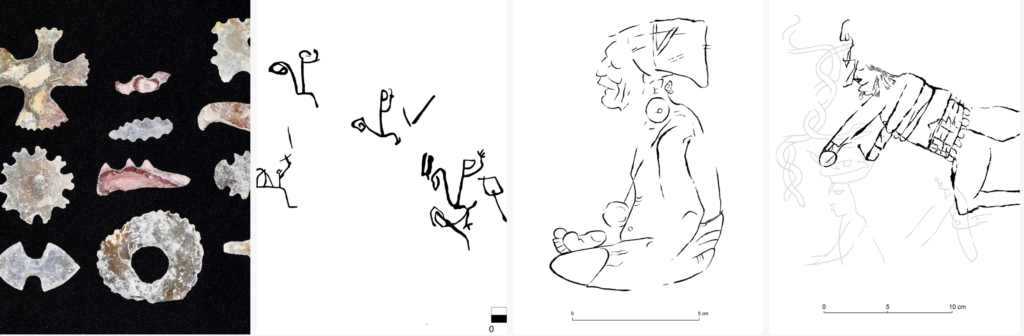
The discovery offers an intimate counterpoint to the royal tomb at Caracol. While the Caracol findings illuminate dynastic power, the drawings at Xunantunich may show how the skills required to maintain Maya government, religion and historical records were taught.
Evidence of Ritual Training and Maya Spiritual Life
Near the possible school, archaeologists excavated a shrine containing the burial of an individual interpreted as a possible shaman. The burial included carved shell disks showing a human figure with the head of a deer interacting with supernatural imagery, as well as unusual flaked chert objects shaped like creatures and cosmic symbols.
Researchers suggest these objects may relate to transformation rituals, communication with the supernatural world and practices such as ceremonial bloodletting. Their location near the proposed educational complex raises intriguing questions about whether some students were trained not only as artists or scribes, but also in religious knowledge.
These interpretations remain part of ongoing archaeological research. Nevertheless, the combination of student housing, practice drawings and ritual material provides rare evidence of how specialized Maya knowledge may have moved between generations.
Why These Finds Matter for Archaeology in Belize
The discoveries at Caracol and Xunantunich illuminate different but connected parts of ancient Maya society. Caracol’s royal tomb provides rare evidence associated with the beginning of a dynasty, while its residential groups reveal continuity, ritual practice and community life beyond the palace environment. Xunantunich’s possible school, practice drawings and ritual burial show how art, writing and sacred knowledge may have been taught.
Together, the finds challenge the idea of an isolated ancient city. Caracol participated in networks that reached other Maya kingdoms and possibly as far as central Mexico. Yet the evidence also reinforces the creativity and agency of the Maya themselves: outside ideas could be exchanged and adapted without replacing locally developed systems of identity and government.
This is what makes archaeology in Belize so compelling. Famous temples represent only the visible surface of a much larger story. Beneath plazas, homes and forest-covered structures are records of families, rulers, beliefs, alliances and innovations still waiting to be understood.
Visiting Caracol and Xunantunich Today
Visitors to Caracol can walk through broad plazas, see carved monuments and stand before Caana, or “Sky Place,” the towering complex that remains one of Belize’s tallest human-made structures. The journey through the Chiquibul Forest is part of the experience, revealing the scale and remoteness of a city that once supported a vast population.
View this post on Instagram
Knowing that archaeological work is still active adds another dimension to a visit. Caracol is not a finished story preserved behind glass; it is a living place of research where new evidence continues to reshape what we know about ancient Maya Belize.
Xunantunich offers a very different but equally rewarding experience. Visitors cross the Mopan River from San José Succotz aboard a traditional hand-cranked ferry before continuing to the hilltop site. From El Castillo, sweeping views stretch across the river valley toward Guatemala, while the plazas, palaces and surviving stucco friezes provide a dramatic introduction to Maya history.
View this post on Instagram
From The Lodge at Chaa Creek, travelers can explore both Caracol and Xunantunich through guided inland adventures, gaining valuable context from experienced Belizean guides who bring architecture, ecology and history together. Visiting responsibly also helps support the appreciation and protection of Belize’s extraordinary cultural heritage for future generations.
View this post on Instagram
From Ancient Maya Heritage to Living Belizean Culture
Belize’s connection to the ancient Maya is not confined to archaeological sites. It continues through living traditions, food and community celebrations across the country. In August 2026, National Geographic Traveler (UK) included Belize’s Chocolate Festival among seven of Latin America’s “unmissable festivals,” highlighting Toledo’s long relationship with cacao and the festival’s mix of chocolate, music and foods inspired by Maya heritage.
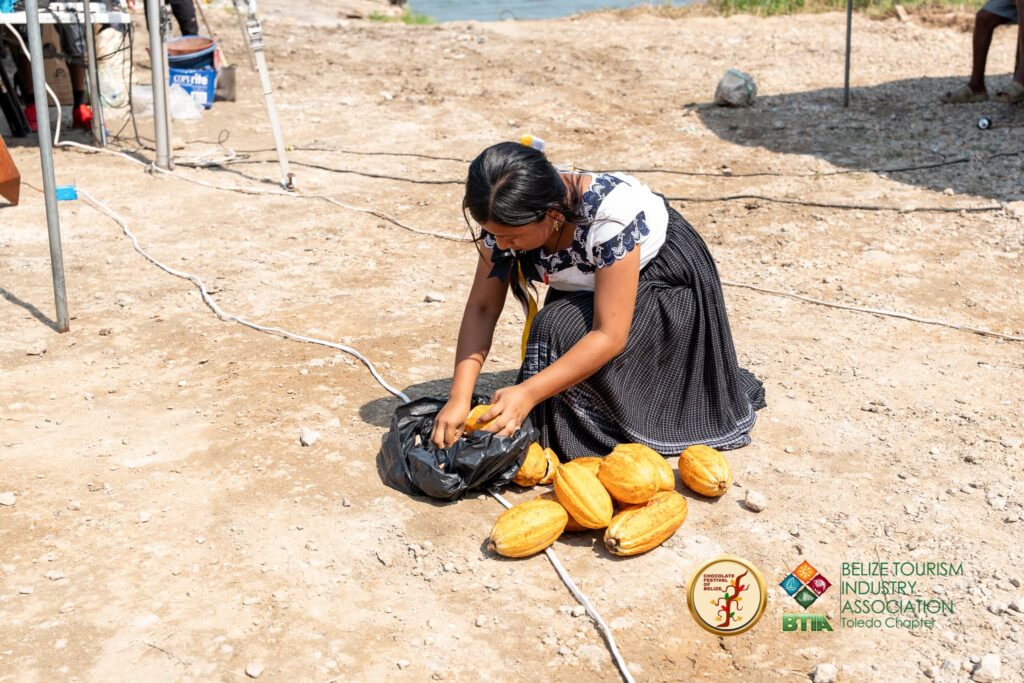
The recognition is a timely reminder that exploring Belize means experiencing both its ancient past and the cultures that continue to carry that heritage forward. The next Chocolate Festival is listed for May 14–17, 2027, an inviting reason to pair a journey into Belizean archaeology with one of the country’s most flavorful cultural celebrations.
Contact us at [email protected] to book your stay or call us on our Vonage phone number 877-709-8708
Primary Source
Chase, Arlen F., Diane Z. Chase and Adrian S.Z. Chase. Positioning the Early Classic Period at Caracol, Belize: Caracol Archaeological Project Investigations During 2025. Report submitted to the Belize Institute of Archaeology, 2026.
https://caracol.org/wp-content/uploads/2026/01/2025-reduced.pdf
Additional Source
O’Donnell, Ben. “Xunantunich, Belize.” Archaeology Magazine, September/October 2026.
https://archaeology.org/issues/september-october-2026/off-the-grid/xunantunich-belize/
Stables, Daniel. “7 of Latin America’s Unmissable Festivals.” National Geographic Traveller (UK), August 26, 2026.